



SWEATOR-SKIN
Climate and textile samples/composites
In its sweat simulation, SWEATOR focuses on generating water vapor and, like humans without physical exertion, does not produce immediate wetness. Our basic model SWEATOR-SKIN enables the testing or comparison of textile samples or textile composites, as used, for example, in ready-to-wear garments. SKIN has a climate field of 14.5 x 19.5 cm. The samples are clamped or placed on top and, in measurement mode, are subjected to a defined input of heat and moisture. It is also suitable for climate simulation in smaller seating systems, such as child seats.
Key data
Shapes:
SWEATOR-SKIN: Box design with “sweat” lid (interchangeable) for microclimate testing of textile samples.
Data acquisition:
T (°C), RH (%), AH (g/kg), HI (°C) = “perceived” T, time, as well as thermodynamic indicators according to the given standard conditions.
Data storage and analysis
Data on SD card (TXT).
We offer customized evaluation tables based on Excel.
T/RH recording:
In the basic product, due to the small area, 4 sensors are provided for T/RH recording; however, as with any SWEATOR, up to 8 slots are available. In principle, a higher number of sensors provides a more representative picture of the climate behaviour; nevertheless, selecting 4 sensors remains our preferred application variant.
Applications
- Determination of the climate properties of textile samples and composites.
- Insight into climate development between humans and textiles.
- Quantitative derivation of the effect of the material-related climate comfort properties.
Downloads (PDF)
Product variations, technical specifications and prices available on request
Contact us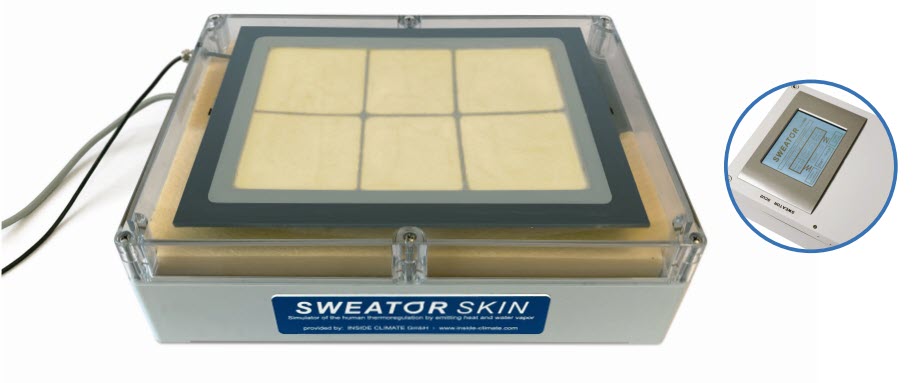
Other products
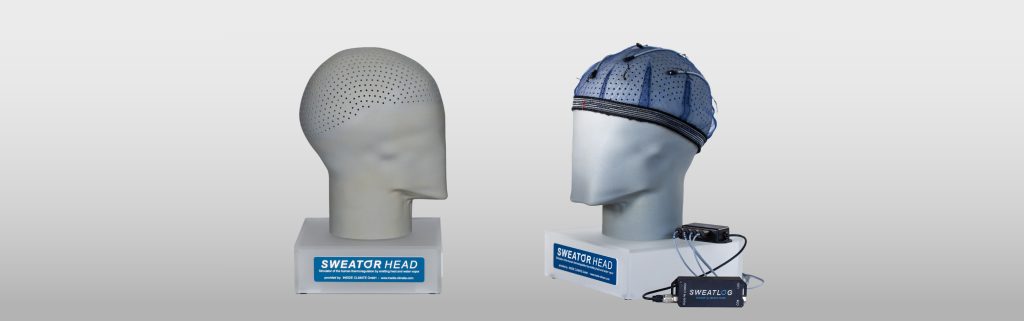
SWEATOR-HEAD
For the analysis and optimization of humidity and heat accumulation in head protection products.
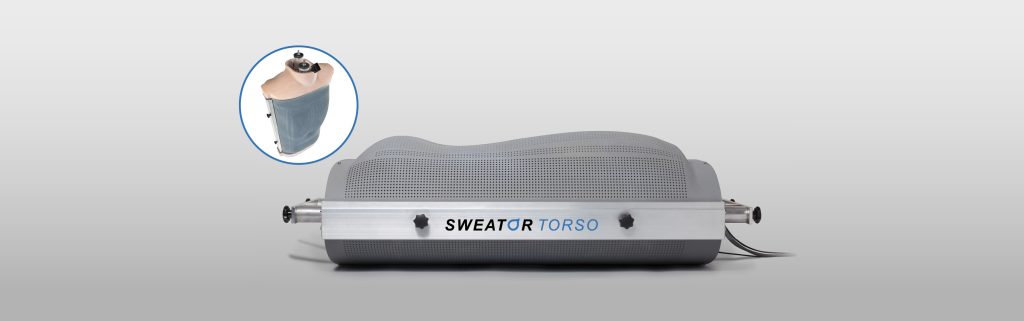
SWEATOR TORSO
Used worldwide in the development of mattresses and sleeping surfaces. Also available as a “stand-up” version for outerwear.
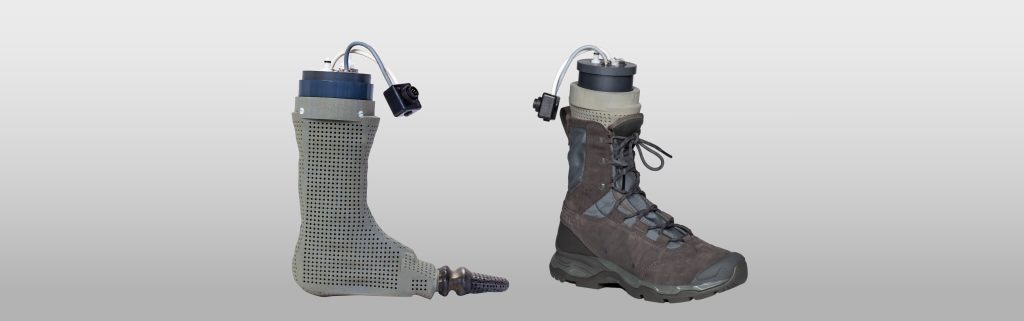
SWEATOR-FOOT
Shoes, boots, stockings, compression garments; the FOOT helps to identify and optimize moisture traps and thermal bridges.